
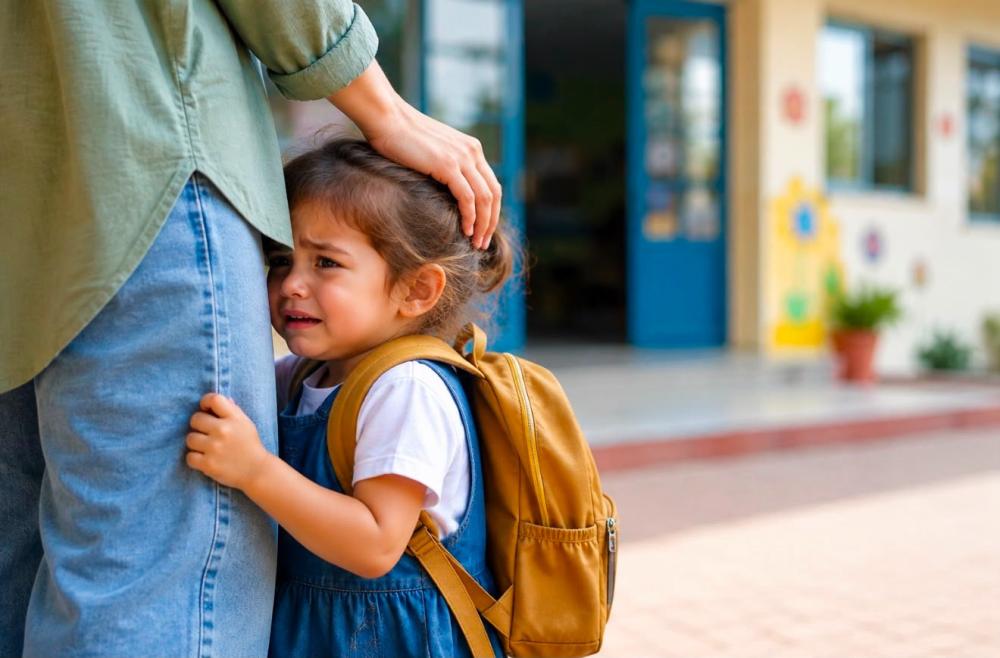
How do you prepare your child psychologically and emotionally for the first day of school, and help him deal with the unknown with confidence?
As the start of the school year approaches, most families are busy buying school bags, preparing school supplies, adjusting sleep schedules, and repeating encouraging phrases.
Despite the importance of all of that, it may not prevent a child from crying at the school gate, clinging to his mother on the first morning, refusing to enter, being extremely angry, or suddenly withdrawing.
The mother wonders: “I have prepared everything… so why is my child still not ready?”
Perhaps because we prepared the school supplies, but we did not adequately prepare the child to deal with the transition itself.
A child is not afraid of school as much as he is afraid of what he cannot predict.
For him, school means a new place, new faces, different rules, an unfamiliar routine, and hours spent away from his parents. The more uncertain what lies ahead, the greater his need for support, gradual progression, and a sense of security.
Research from the Center on the Developing Child at Harvard University indicates that executive functions help children focus, control impulses, remember instructions, switch between tasks, and adapt to new situations. The center describes them as being like an air traffic control tower; they help children organize their thoughts and behavior and make decisions in everyday situations.
Research by Canadian neuroscientist Adele Diamond also indicates that these skills are not fixed abilities that a child is born with, but can be developed gradually through play, practice, and age-appropriate daily experiences.
When we understand how a child's brain deals with new situations, it becomes easier to help them in a way that is consistent with their normal development.
Therefore, it is not enough to tell him: “Don’t be afraid… the school is beautiful.”
Rather, we need to help him understand what will happen, provide him with opportunities to practice some self-regulation skills, and at the same time maintain his sense of security and connection.
Before we begin, it is worth remembering an important fact:
Children at this stage learn more through experience and play than through lengthy explanations. Therefore, the best methods of preparation are those that the child lives and experiences firsthand.
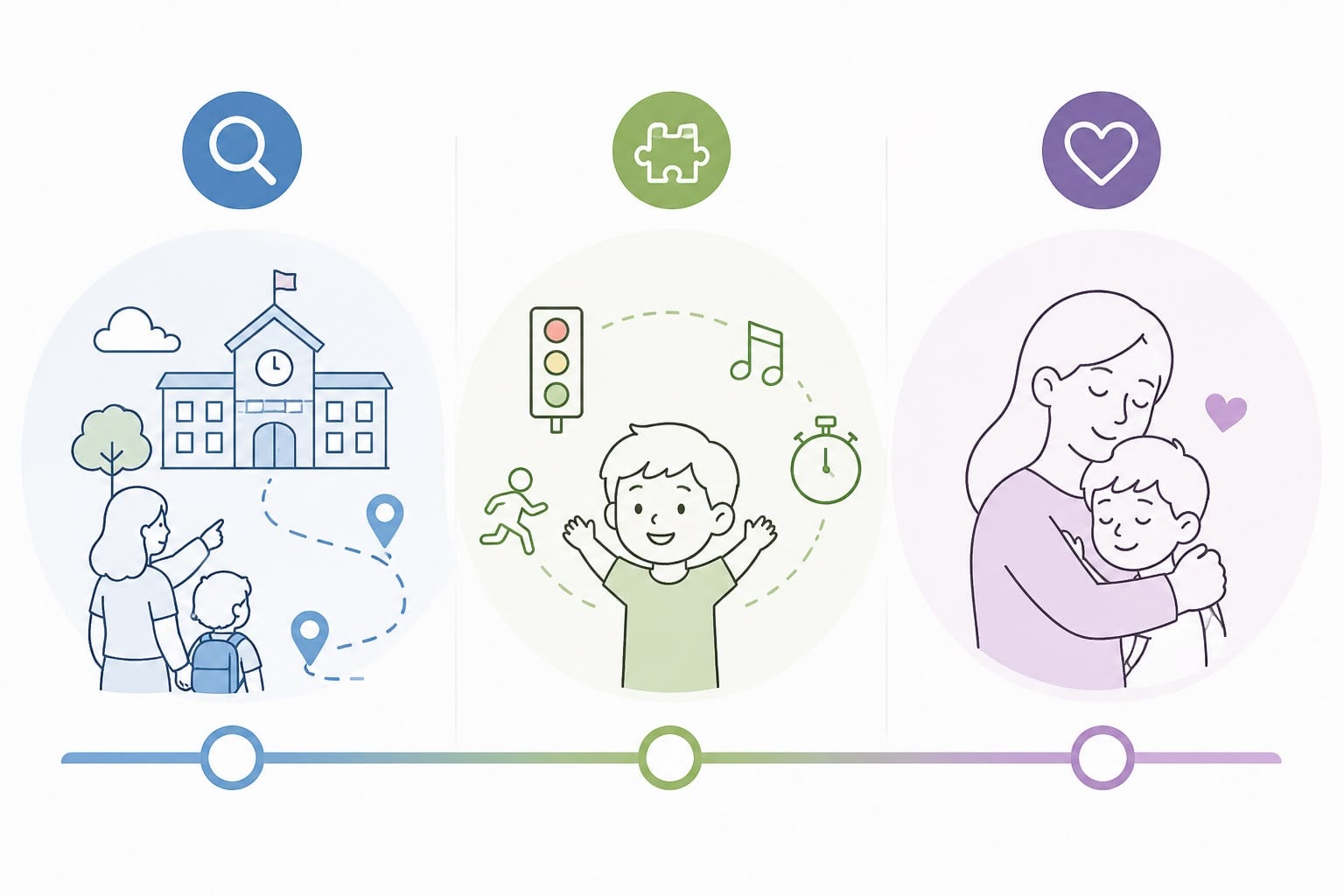
First step: Make the unknown known
A child feels safer when they know what to expect.
If possible, take him on a short visit to the school before the start of the school year, and make it a simple tour in which he can discover the place.
I show him:
Where will he enter from?
Where will he put his bag?
Where is the restroom located?
Where will he sit?
Who is his teacher?
What will happen after he enters the classroom?
Next, turn the school day into a short story whose events he can predict, such as:
“We will enter the school, then greet the teacher, then put the bag in its place, then sit with the children, listen to the story, and then we will play and learn.”
The steps of the day can also be illustrated using simple pictures or symbols.
The goal is not for the child to memorize this sequence verbatim, but rather to move from the idea of:
"I don't know what will happen."
to me:
"I know pretty much what's going to happen."
Studies show that the more predictable a child feels their environment is, the lower their stress level becomes, and the more adaptable they are to change.
⸻
Step two: Train self-regulation skills through play
We might think that sitting quietly, listening, waiting our turn, and following instructions are skills that a child learns at school.
But the truth is, he can practice it long before that… through playing.
Try playing simple games with him, such as:
Traffic light game
🟢 Green: The child moves.
🔴 Red: Stops completely.
Then gradually add new instructions or colors.
or:
Statue game
Play the music, let the child move freely, and when the music stops, he freezes in place.
or:
Follow the Leader game
The child performs the movements or instructions given by a parent, changing them between fast and slow, right and left, or jumping and standing.
These games may seem simple, but they train the child in attention, response control, mental flexibility, and following rules, all of which are essential skills for the executive functions he needs in the classroom.
Reading stories that deal with order, waiting in line, and respecting rules also helps to instill these skills in a natural and enjoyable way.
⸻
Step three: Build an emotional bridge between home and school.
Some children are not afraid of the school itself, but of being separated from the person who gives them a sense of security.
Therefore, the child needs an emotional bridge that connects home and school.
One of the most beautiful ways to bridge this gap is for the parents to agree with the child on a prayer to recite every morning, such as:
“I entrust you to God, in whose care nothing is ever lost.”
The child says:
“I have accepted God’s deposit.”
Or he might say:
“My Lord, protect me as You protect Your righteous servants.”
The purpose of prayer is not to prevent the child from feeling afraid, but to give him a sense of security, and to instill in his heart that God is with him and protects him wherever he is.
A simple symbol can also be agreed upon if the school allows it, such as a small heart drawn on the child's hand and the hand of one of his parents, or any special symbol between them that reminds him that the one who loves him is waiting for him and will return to him.
He can also be taught to say to himself when he feels nostalgic:
“Mom dropped me off at school… and she’ll come back to pick me up when the day is over.”
The goal is not to prevent the child from feeling fear or longing, but to help him understand his feelings, tolerate them, and be reassured that they are temporary.
School doesn't begin at the school gate.
Preparing a child for school does not begin with just buying a bag or apron, nor does it mean forcing him to “grow up” suddenly.
It begins days before, when we help him understand what awaits him, give him opportunities to play and practice, and build in him a sense that this new world can be understandable and safe.
The baby may cry on the first day despite all of that. This does not mean that the preparation has failed.
Crying may simply be his way of expressing strong emotions that he is still learning to regulate.
Our goal is not to silence his crying, but to give him the tools that will help him regain his sense of security, gradually return to calmness, and then participate and learn.
We may buy the bag in an hour, but preparing the child may take several days, and these days may be among the most important things we give him before the start of his school journey.
Therefore, instead of asking: “Did we buy the bag and the apron?”
Let's also ask: "Have we prepared our child psychologically and emotionally for what will happen behind the school door?"
Remember…a child doesn't learn when they feel afraid, but when they feel safe. And safety is the first lesson they need before they learn letters and numbers.